On a rainy afternoon, when most people hurry past puddles and roadside ditches without a second glance, one man noticed something unusual.
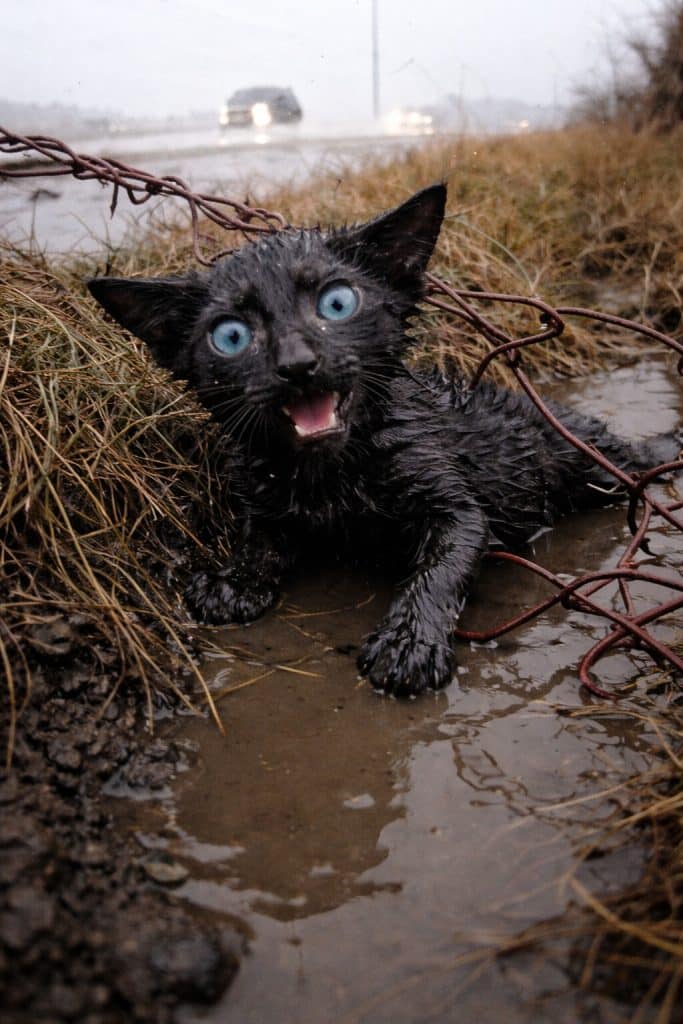
In a shallow drainage ditch beside the road, a tiny black shape lay trembling. It was soaked through, shivering, and crying out weakly over the sound of the rain. At first glance, it looked like nothing more than an abandoned kitten—small, fragile, and desperately in need of help.
Without hesitation, the man reached down and lifted the little creature from the cold water. It fit easily in his hands. Wet fur clung to its body, and its cries softened the moment it felt warmth. At that moment, there was no doubt in his mind: this was a kitten that had somehow ended up in the wrong place at the wrong time.
He brought her home.
The First Weeks: Care, Warmth, and Quiet Hope
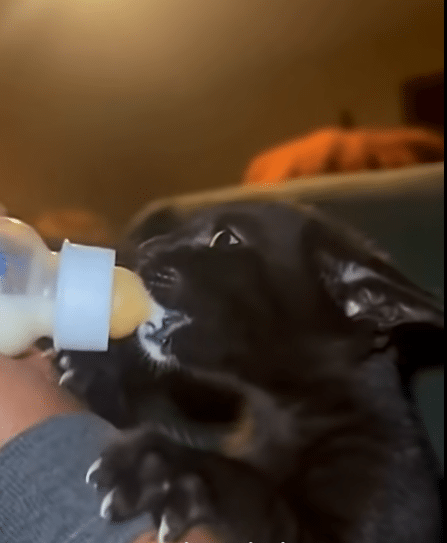
Those early days followed a familiar rhythm. Bottles every few hours. Gentle cleaning. A warm place to sleep. The small animal drank eagerly, clinging to the routine with surprising determination. She seemed grateful, calm, and unusually focused when feeding.
Video: The Day He Realized She Wasn’t a House Cat at All
Nothing felt alarming at first. If anything, she appeared stronger than expected for such a young kitten. Her grip was firm. Her appetite steady. Her eyes watched everything.
It was easy to believe the story would end there—with a rescued stray growing into an ordinary house cat.
But time had other plans.
Month Two: A Strength That Didn’t Match Her Size
By the second month, subtle differences began to surface.
During feeding, her jaws clamped down with unusual force. The man noticed deep punctures forming in the rubber bottle nipples—marks far sharper than any kitten he’d cared for before. Her claws, too, seemed exceptionally strong, capable of tearing through materials that normally held up just fine.
Still, growth can vary. Kittens develop at different speeds. He brushed off the concerns, assuming she was simply a particularly robust cat.
Yet something about her energy felt… different.
She wasn’t aggressive. She wasn’t fearful. But her strength didn’t match her appearance.
Month Six: When the Signs Became Impossible to Ignore
At six months old, the illusion finally began to crack.
She was much larger now—longer, heavier, more powerful than expected. One afternoon, she got hold of a pair of leather work boots left near the door. By the time he noticed, the damage was already done. Thick leather had been torn apart as if it were fabric.
That was the moment curiosity turned into concern.
Then came the detail that changed everything.
While watching her in the light, he noticed her eyes more carefully than ever before. Her pupils were round. Perfectly circular. Not the vertical slits typical of domestic cats.
It was a small detail—but a crucial one.
That difference suggested something extraordinary. She wasn’t just a stray cat. She belonged to a very different lineage.
The Quiet Realization
Experts later confirmed what he had begun to suspect.
The animal he had pulled from the roadside ditch was not a domestic kitten at all. She was a young wild cat—likely from the big cat family, similar to a black panther or leopard.
The realization came with mixed emotions.
There was awe at her beauty and resilience. Gratitude that she had survived. And a deep sense of responsibility—for raising a creature that was never meant to be ordinary.
One Year Later: Trust, Bond, and an Unusual Relationship
Despite her wild origins, the bond between them remained strong.
By the one-year mark, she had grown into a powerful, confident animal—yet she still sought out affection in familiar ways. She leaned into gentle touches. She purred when scratched behind the ears. She followed him closely, responding to his presence with unmistakable trust.
She wasn’t tame in the traditional sense. Her instincts were intact. Her strength undeniable.
But the connection was real.
It was built slowly, through consistency, patience, and respect.
A Story About Perception—and Responsibility
This wasn’t just a story about mistaken identity.

It was a reminder of how easily wild animals can be misunderstood, especially when they are young and vulnerable. At birth, the differences between species can be almost invisible. But nature always reveals itself in time.
The man didn’t set out to raise something extraordinary. He simply responded to a life in need.
What followed was a journey that required learning, humility, and difficult decisions—about safety, care, and the boundaries between wild and domestic worlds.
Why Stories Like This Matter
For readers, especially those drawn to rescue stories, it’s tempting to focus only on the miracle moment—the save, the transformation, the bond.
But this story also highlights something deeper: compassion must be paired with knowledge. Love must be guided by responsibility.
Not every animal found in distress belongs in a living room. Not every rescue ends with a simple ending.
Yet the instinct to help—to stop, to notice, to act—still matters.
Because without that moment in the rain, this story would never have begun.
And without care, patience, and respect for what she truly was, it could not have ended in trust.
Sometimes, the smallest discoveries lead us into the most unexpected truths.